
Why Consistency in Testing Matters
Every SAP has experienced it — you complete a thorough assessment, set clear education and treatment requirements, and then leave the testing step in the client’s hands. The result? Inconsistent test quality, mismatched cutoff levels, and gaps in reporting. One client might use a cheap rapid test at 100 ng/mL, another might find a lab that doesn’t align with DOT standards, and suddenly you’re left trying to interpret results that don’t provide the insight you need.
This inconsistency creates risk:
For the client
They may believe they’re “clean” from a weak non-DOT test, only to fail a DOT test later.
For the SAP
Testing is done at different standards that are chosen by the client.
For the employer
Confidence is shaken in the RTD process if the client fails the RTD test.
That’s why more SAPs are standardizing with PracticeDrugTest.com.
Understanding Alcohol Monitoring with EtG Testing
Alcohol use presents a different challenge than drug testing. Alcohol leaves the bloodstream quickly, which means a breath test or standard alcohol screen only detects use for a short period of time.
To monitor abstinence more effectively, many programs use an EtG test.
EtG stands for Ethyl Glucuronide, a metabolite created when the body processes alcohol. Because EtG remains in the urine longer than alcohol itself, it allows testing to detect alcohol consumption after the alcohol has already left the bloodstream.
Typical EtG detection windows:
• Light alcohol consumption may be detectable for about 24 hours
• Moderate drinking can often be detected for 24 to 48 hours
• Heavier consumption may be detectable for up to 72 hours or longer
This makes EtG testing useful when abstinence from alcohol is required during a monitoring period.
EtG results are typically reported in nanograms per milliliter (ng/mL), providing measurable documentation of alcohol exposure levels rather than simply a pass or fail result.
Most monitoring programs use a cutoff level of 500 ng/mL. This threshold is designed to reduce the likelihood that incidental exposure to alcohol containing products, such as certain mouthwashes or medications, produces a positive result while still identifying recent alcohol consumption.
Why EtG matters in monitoring programs
When alcohol abstinence is required, relying only on breath alcohol testing creates a gap in detection. EtG testing helps close that gap by identifying recent alcohol consumption even when the alcohol itself is no longer present.
This provides:
• stronger accountability
• clearer documentation
• greater confidence in abstinence monitoring
By incorporating consistent laboratory testing methods, SAPs can maintain the same level of confidence in alcohol monitoring that they expect from drug testing.
Our Service Ensures

Consistency
Every test uses a federally aligned non-DOT panel with the same cutoff levels as DOT, ensuring no weak links in the process.

Detailed reporting
If positive, results show the exact nanograms per milliliter (ng/mL), giving both you and your client precise insight into their levels.

Accountability
Every order produces a lab-based, chain-of-custody CCF, so you know the test was done correctly and is defensible if questioned.

Time savings
No more chasing clients about where or how they tested. You set the standard, and the client follows a clear, simple process.
DOT Confirmatory vs. Other Non-DOT Initial Screen Cutoffs (ng/mL)
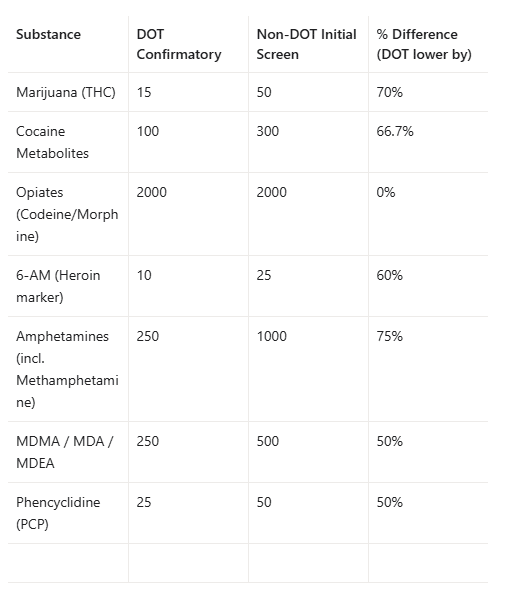
When SAPs leave testing up to clients, they risk inconsistency. When SAPs direct clients to PracticeDrugTest.com, they gain confidence, uniformity, and the added benefit of documented levels that help guide future conversations. It’s not just about passing a test — it’s about protecting the integrity of the RTD process.